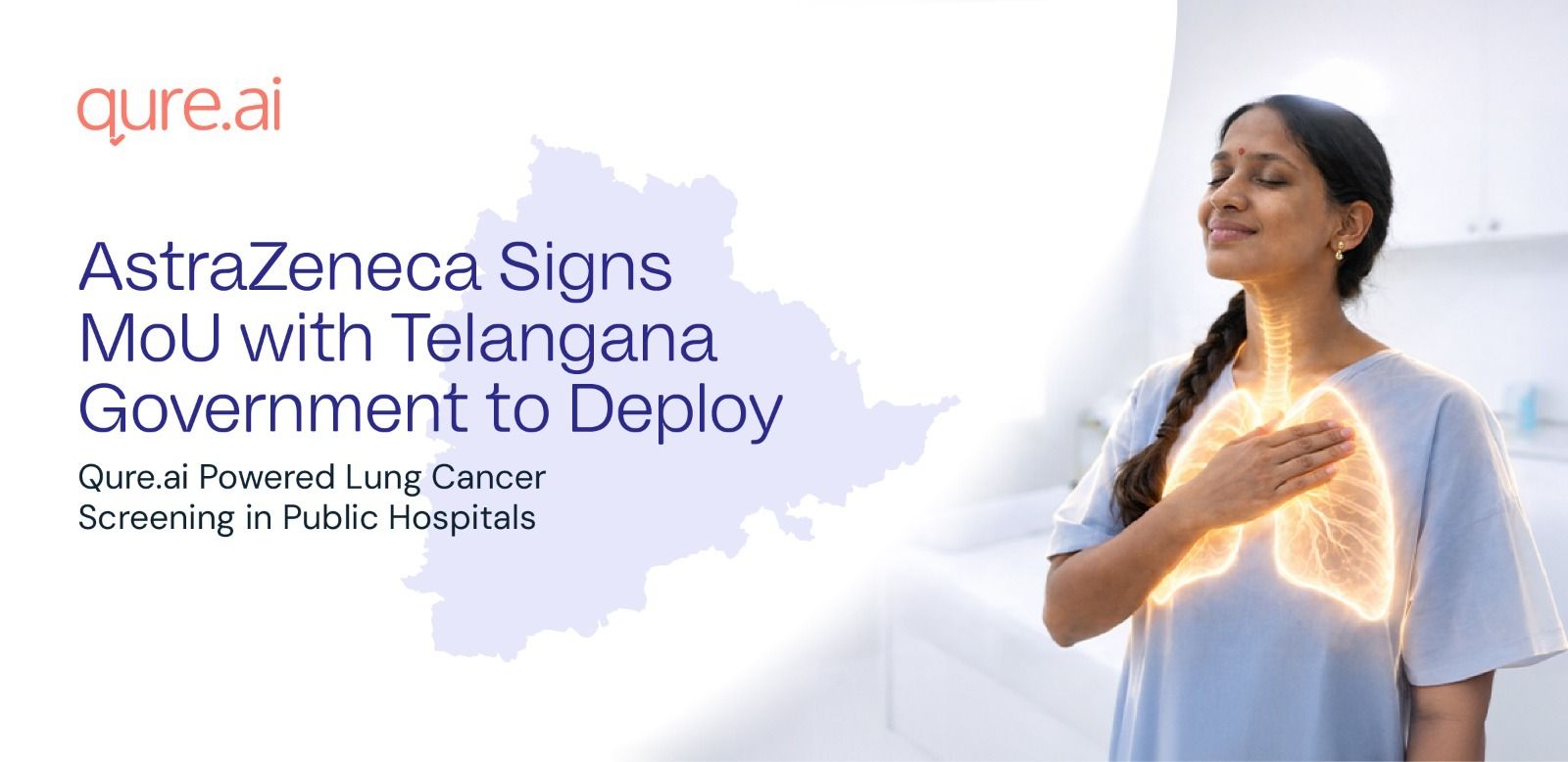
AstraZeneca Pharma India Limited today signed a Memorandum of Understanding (MoU) with the Government of Telangana to introduce AI-enabled lung cancer screening across public healthcare facilities in the state, powered by Qure.ai’s AI-driven chest X-ray solution. The collaboration aims to strengthen early detection and improve outcomes for patients in both urban and rural areas.

Back
Lung cancer is among the most pressing public health challenges in India today. Patients flagged as high risk will be referred for confirmation tests or follow-up care. The initiative comes as lung cancer cases continue to rise in India, from approximately 63,700 cases in 2015 to more than 81,200 in 2025, with about 80%-85% of patients being diagnosed at advanced stages, contributing to nearly 60,000 deaths annually. The disease is also no longer confined to smokers: cases among non-smokers are rising by 30–40%, making broad, population-level detection efforts increasingly important.
Telangana reflects these national pressures acutely. The state is projected to record 46,762 new cancer cases among adults in 2026, rising to 47,314 by 2030—an estimated 13% increase by 2027. Women bear a disproportionate share, with 25,510 new cases expected this year compared to 21,252 in men. According to the Telangana Cancer Burden Profile 2026, published by ICMR-NCDIR, one in six women in Hyderabad faces the risk of developing cancer in her lifetime, while one in eight men is likely to receive a diagnosis before the age of 74. Low awareness, cost barriers, and limited access in rural areas compound the challenge, often delaying diagnosis until the disease has progressed beyond curative treatment.
Early detection fundamentally changes this equation. Screening programmes that identify lung cancer at earlier stages can enable curative therapies for a significantly larger proportion of patients, improving survival outcomes and reducing the overall burden on the health system.
Under the MoU, AstraZeneca will facilitate the deployment of Qure.ai’s AI-powered chest X-ray solution, integrated into routine workflows at public health facilities across Telangana. The technology helps clinicians flag high-risk pulmonary nodules—a predominant precursor of lung cancer, along with 29 other lung conditions. High-risk patients will be triaged for diagnostic confirmation or follow-up, enabling a stage shift in lung cancer detection. A similar model has already been adopted in Goa, Tamil Nadu, and Karnataka.
Dr. S. Sangeetha Satyanarayana, Commissioner, Health & Family Welfare Directorate, Government of Telangana, said, “Telangana is witnessing a steady rise in cancer cases, and late diagnosis due to limited screening uptake remains a major challenge. This collaboration integrates technology into routine public healthcare to bridge gaps in access and capacity and reflects our continued focus on building a more proactive, future-ready health system.”
Praveen Rao Akkinepally, Country President & Managing Director, AstraZeneca Pharma India Ltd., said, “We sincerely thank the Government of Telangana for spearheading this initiative. Early detection plays a defining role in improving cancer outcomes, particularly in diseases like lung cancer, where diagnosis often happens at advanced stages. At AstraZeneca, partnerships are part of our broader commitment to expanding access to innovative healthcare solutions in India. We believe such collaborations can drive meaningful impact by bringing early diagnosis closer to communities that need it the most.”
Sagar Sen, Senior Vice President, Global Life Sciences and Strategic Alliances, Qure.ai, said, “Early detection remains one of the most critical levers in improving lung cancer outcomes. Through this collaboration in Telangana, we are integrating AI into routine chest X-ray workflows to help clinicians identify high-risk cases earlier and prioritise them for timely follow-up. At Qure.ai, we build scalable public health solutions, and this initiative expands access to early diagnosis.”
The initiative is expected to roll out across 20 public health facilities, covering both urban and rural health systems. It includes training and upskilling of healthcare professionals to support effective and sustainable adoption, as well as infrastructure enhancements where needed to ensure seamless integration into the public health system.