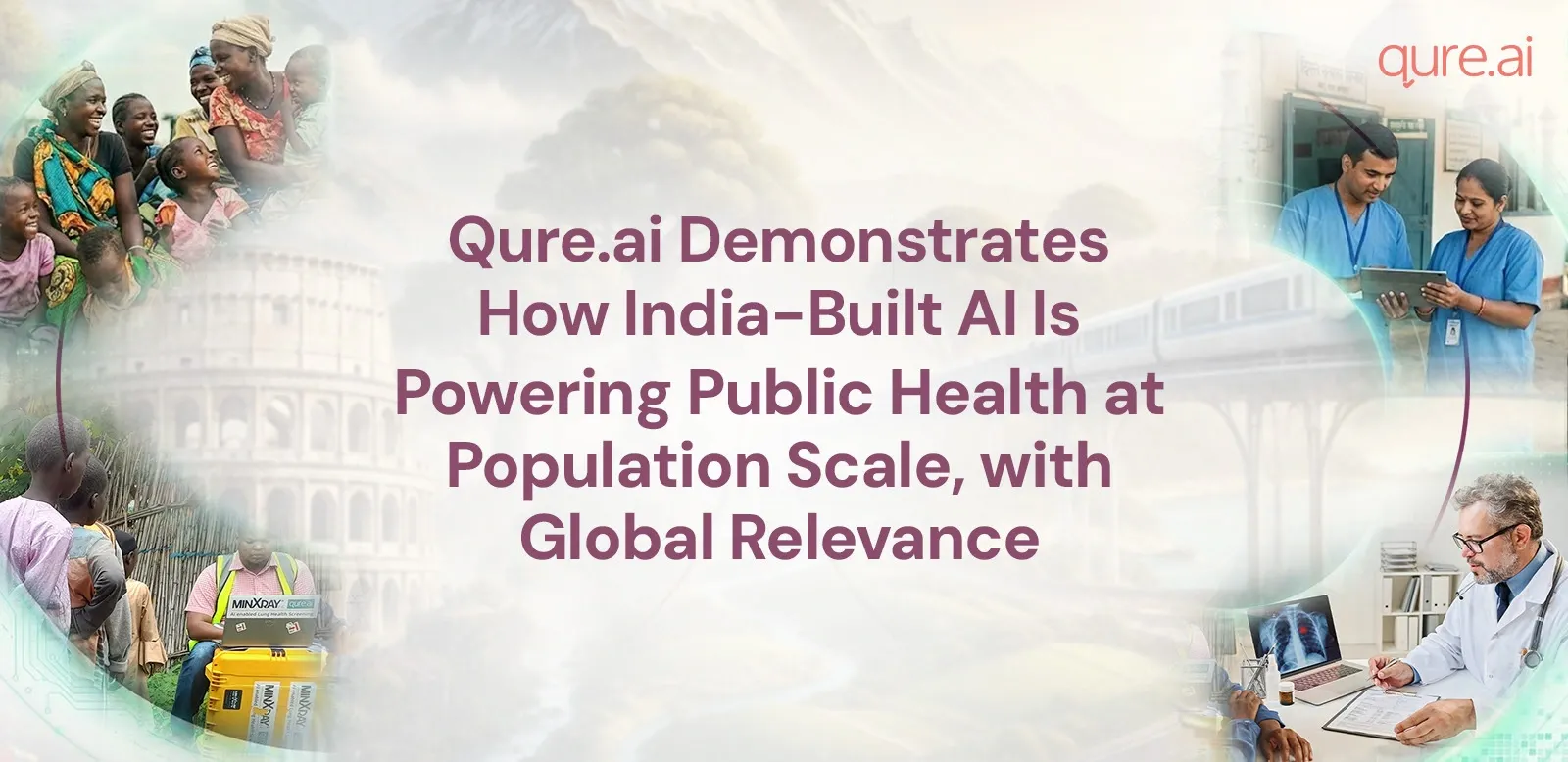
At the India AI Impact Summit 2026, Qure.ai outlined how AI can be embedded within public health systems to support population-scale screening and disease surveillance. The discussion took place during the panel, “Public Health Powered by AI: RailTel’s Collaborative Model for AI-enabled Inclusive Healthcare for Bharat and Beyond,” which examined how AI can be implemented within national health programmes as part of routine service delivery. The session brought together senior public health leaders from government, global health institutions, academia, and industry to discuss how AI can be deployed at scale within national health systems.

Back
The panellists included Sunil Kumar Barnwal, CEO, National Health Authority; Prof. Anubha Gupta, Professor, Indraprastha Institute of Information Technology, Delhi; Jean Philbert Nsengimana, Chief Digital Advisor, Africa Centres for Disease Control and Prevention (Africa CDC); and Ankit Modi, Chief Strategy & Growth Officer, Qure.ai. The session was moderated by Shri K. Manohar Raja, Principal Executive Director, RailTel Corporation of India Limited.
“Public sector digital infrastructure plays a key role in helping proven and widely deployed health technologies scale at the population level,” said Shri K. Manohar Raja, Principal Executive Director, RailTel. “By providing reliable networks and systems, institutions like RailTel can support technology companies in expanding deployments across public programmes in India and beyond, helping reduce implementation friction.”
Emphasising the importance of national digital foundations, Sunil Kumar Barnwal, CEO of the National Health Authority, highlighted how India’s public digital health architecture enables AI adoption at scale. “Digital foundations like Ayushman Bharat Digital Mission are designed to support integrated care delivery across the country. When AI-enabled diagnostics are embedded within these systems, they can help shift healthcare from reactive treatment to proactive risk identification, enabling better monitoring and informed policymaking at a national level,” said Barnwal.
Speaking on the panel, Ankit Modi, Chief Strategy & Growth Officer, Qure.ai, noted that the real challenge for health systems is not access to technology, but sustained deployment of it at scale. He pointed out that when AI is embedded into routine screening programmes, it enables continuous disease surveillance, early detection and structured population-scale screening. By generating real-time, population-level insights through integrated dashboards, AI systems support proactive identification of high-risk individuals.
It is the first Indian AI company recommended by the World Health Organization for autonomous tuberculosis screening, reflecting its clinical rigour and relevance to public health systems. Qure’s AI tools are deployed within national disease surveillance programmes in countries including Malaysia, Thailand, El Salvador, and Colombia, and are used across diverse care settings ranging from rural primary health centres to tertiary hospitals.
“Our experience across large public health programmes shows that embedding AI into routine screening and diagnostic workflows delivers immense clinical value,” said Ankit Modi, Chief Strategy & Growth Officer, Qure.ai. “It helps health systems manage workload more efficiently, even in settings with limited infrastructure. Deployments at India’s scale demonstrate how public health AI can be implemented reliably and adapted by other health systems across the world.”
The discussion underscored the importance of treating AI as part of public health infrastructure rather than a standalone tool. The session highlighted how collaboration between government institutions, public sector entities, and technology providers can enable AI to be implemented within regulatory frameworks and public programmes. It also reflected the growing readiness of Indian health systems to evaluate and adopt proven AI solutions in a structured and accountable manner.